The american college of sports medicine just named wearable technology the 1 global fitness trend for 2026 for the seventh year in a row. that’s not hype. there are now an estimated 640 million smartwatch users worldwide, and roughly 614 million wearable devices will ship this year alone.

The catch? Walking into this market in 2026 is overwhelming. Smartwatches, smart rings, recovery guns, sleep mats, AI nutrition coaches, glucose monitors aimed at people who don’t even have diabetes the category has exploded into a $96 billion global industry, and most of the products screaming for your attention won’t actually move the needle on your health.
This guide cuts through the noise. We’ll cover what health and fitness technology actually is in 2026, the four categories that matter, the metrics worth tracking (and the ones you can ignore), how to choose the right tools for your specific goals, and the trends quietly reshaping the entire space. By the end, you’ll have a clear framework for building your own health tech setup – without throwing money at gadgets you’ll abandon in three weeks.
What Counts as “health and fitness technology” in 2026?
A decade ago, fitness tech meant a pedometer and maybe a heart rate strap for the gym. That’s not the world we live in anymore.
today, health and fitness technology refers to any connected device, sensor or software that helps you measure, understand or improve a physical or mental health outcome. The category has expanded in three directions at once:
- From step counting to continuous biometric monitoring – modern wearables track heart rate variability, blood oxygen, skin temperature, stress, and sleep architecture, 24 hours a day.
- From data to insights – AI now interprets that raw data and tells you what to actually do with it. Roughly 40-50% of new wearables launched in 2026 include AI features baked in.
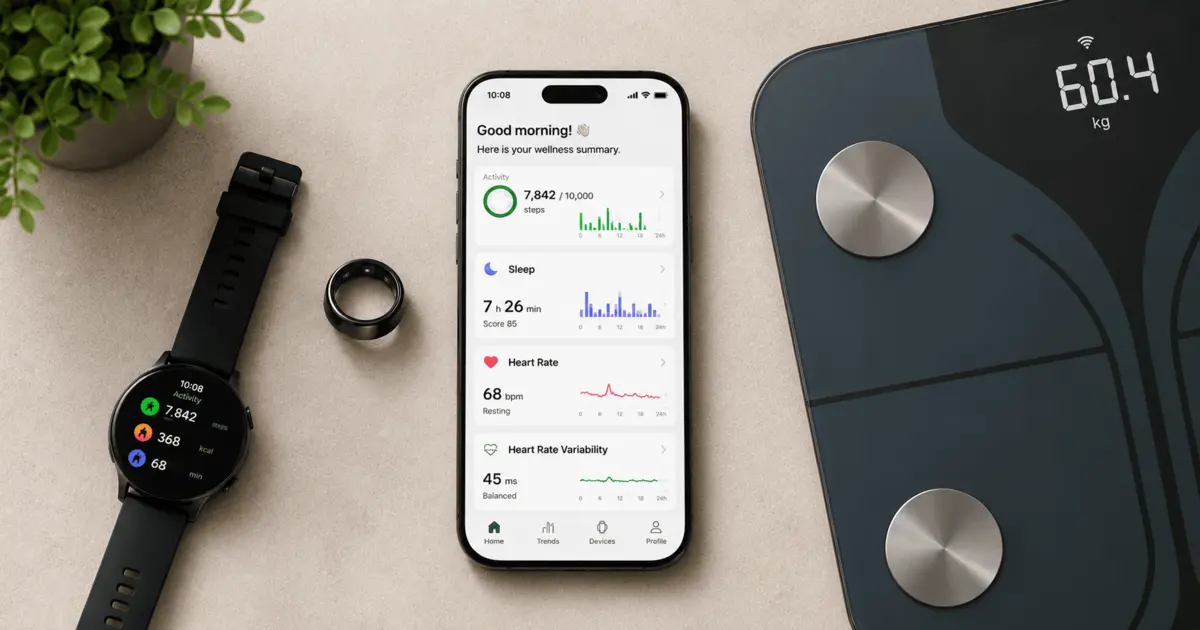
- From individual products to ecosystems – a smartwatch on its own is fine. A smartwatch that talks to your smart scale, syncs with a nutrition app, and triggers a recovery protocol on your massage gun is something else entirely.
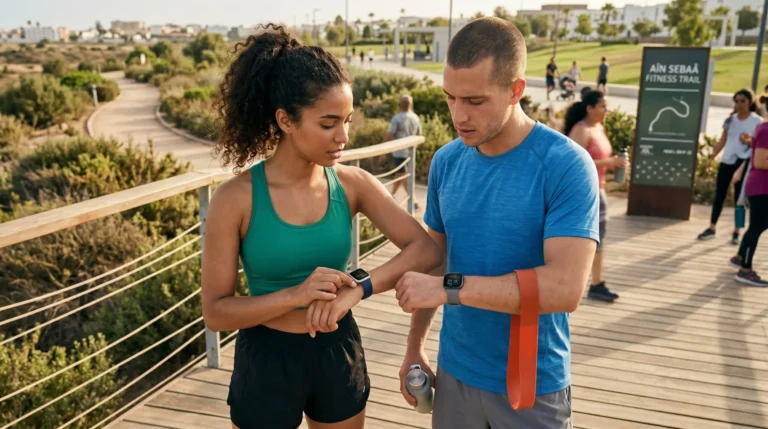
The reason this matters: the average consumer now interacts with health data daily. According to recent industry research, 62% of consumers globally use wearable devices for health and fitness tracking, and 70% prioritize features like ECG, SpO2 and heart monitoring when buying one. Health tech has gone from optional to expected.
The 4 main categories of health & fitness technology
If you’re trying to map this space for the first time, almost every product on the market falls into one of four buckets. Knowing which bucket you actually need is half the battle.
1. Wearables and Trackers
This is the biggest category by far, and it splits into three sub-types:
- Smartwatches : full-featured devices like Apple Watch, Samsung Galaxy Watch, and Garmin Fenix. They handle notifications, payments, fitness tracking, ECG, and increasingly act as a small health computer on your wrist. Smartwatches alone make up roughly 46% of the entire wearable market.
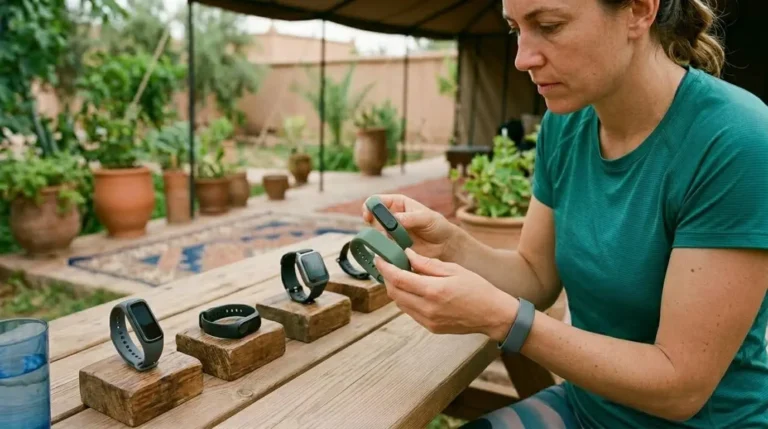
- Fitness bands : simpler, cheaper, and often longer battery life. Fitbit Charge, Xiaomi Mi Band, and Whoop straps live here. They focus on movement, heart rate, and sleep without the smartwatch overhead.
- Smart rings : the breakout category of 2025-2026. Oura Ring 4, Samsung Galaxy Ring, and RingConn Gen 2 Air pack continuous health tracking into something you barely notice on your finger. Ideal for sleep, HRV, and recovery without wrist real estate.
Beginner tip: if you’ve never owned a tracker, start with a band or entry-level smartwatch. Premium devices like Whoop or Garmin Fenix are over-engineered for someone still figuring out which metrics they actually care about.
for a deeper breakdown of how these sensors work, see our guide on how fitness trackers work, and for the year’s biggest head-to-head comparison, our Apple Watch vs Fitbit breakdown.
2. Smart Health Gadgets
These are home devices, usually larger than a wearable, that measure something specific:
- Smart scales : body weight plus body composition (fat percentage, muscle mass, water, bone density) via bioelectrical impedance. Withings, Renpho, and Eufy dominate this space.
- Blood pressure monitors : Bluetooth-connected cuffs that log readings to an app. Useful if you have hypertension or a family history of cardiovascular issues.
- Continuous glucose monitors (CGMs) : historically diabetic-only, now being marketed to general consumers in 2026 after the FDA’s January wellness exemptions. Whether you need one is another conversation.
- Smart thermometers, pulse oximeters, sleep mats : single-purpose tools for specific use cases.
for most people, a good smart scale plus a wearable is a complete home setup. You don’t need eight gadgets.
3. Recovery and Performance Tech
This category has exploded since 2022:
- Massage guns : Theragun, hyperice hypervolt, and a wave of strong budget options. percussion therapy for muscle recovery and pre-workout activation.
- Compression boots : normatec, therabody recoveryair. used to be a pro-athlete thing. now you can buy them for around $700.
- Red light therapy panels : disputed evidence base, growing market.
- Cold plunge tubs and saunas : outside the scope of “tech” for some people, but increasingly app-connected and trackable.
Massage guns are the entry point for most people see our roundup of the best massage guns of 2026 if you’re starting here.
4. Wellness Apps and Software
The least visible category, but often the most impactful:
- Meditation apps : calm, headspace, Insight timer. see our meditation apps comparison for which is right for you.
- Sleep tracking apps : sleep cycle, pillow, autosleep, and the best sleep tracking apps of 2026.
- Nutrition and macro tracking : myfitnesspal, cronometer, macrofactor.
- Workout programming and coaching : strava, hevy, future, caliber.
- Habit and mood trackers : streaks, daylio, bearable.
The biggest behavioral leverage in your health stack is usually in this category, not the hardware. A $15/month nutrition app will out-perform a $400 smartwatch for most weight-management goals.
The Health Metrics That Actually Matter (Decoded)
Modern wearables can throw 30+ metrics at you. Most of them are noise. Here are the ones worth understanding.
| Metric | What it measures | Why it matters |
|---|---|---|
| Resting heart rate (RHR) | Beats per minute when fully rested | A reliable indicator of cardiovascular fitness – lower is generally better. Trends matter more than absolute numbers. |
| Heart rate variability (HRV) | Variation between successive heartbeats | The strongest single indicator of recovery and nervous system state. Low HRV = under-recovered. |
| VO2 max (estimated) | Maximum oxygen uptake during exercise | A proxy for aerobic fitness. Useful for long-term tracking, less useful day to day. |
| Sleep stages | Time spent in light, deep, REM sleep | Deep and REM sleep are when most physical and cognitive recovery happen. |
| Sleep efficiency | % of time in bed actually asleep | Often more useful than total hours. 85%+ is solid. |
| SpO2 (blood oxygen) | Oxygen saturation in the blood | Mostly useful for spotting sleep apnea or altitude issues. Not a daily metric. |
| Recovery / readiness score | Composite score from HRV, sleep, RHR | The most actionable single number wearables produce. |
| Steps and active minutes | Movement throughout the day | Useful as a behavioral nudge. Don’t obsess over the 10,000 number – it’s a marketing artifact, not a scientific threshold. |
The metrics you should largely ignore until you have a reason to care: estimated calorie burn (wildly inaccurate on most wearables studies have shown error rates of 25-90%), stress scores (mostly derived from HRV anyway), and proprietary “energy” or “body battery” scores (vendor-specific repackaging of the same underlying data).
for a complete walkthrough of how sensors capture these signals, read how do fitness trackers work and how smart scales work.
How to choose the right health tech for your goals
The single biggest mistake beginners make is buying a device first, then trying to figure out what to do with it. Reverse the process start with the goal, then pick the tools.
If your goal is weight management or body composition
You need three things: a way to measure inputs (food), outputs (movement), and the result (body composition over time).
- Nutrition app : MyFitnessPal, Cronometer, or MacroFactor. Pick one. Logging consistency matters more than which one.
- Smart scale with body composition : Withings Body+ or Renpho. Weigh yourself the same way, same time, three times a week. Track the trend, not daily fluctuations.
- Basic fitness tracker : any band that logs movement and heart rate. You’re using it for behavioral feedback, not precision.
If your goal is better sleep
- Smart ring or sleep-focused tracker : Oura, Whoop, or a Garmin if you want a watch you wear anyway. Rings excel here because they’re more comfortable overnight.
- Sleep app : for understanding the data and getting actionable nudges.
- Optional: smart mattress or pad : Eight Sleep is the leader but expensive.
If your goal is athletic performance
- Premium GPS sports watch : Garmin Fenix or Forerunner, COROS, or Apple Watch Ultra.
- Heart rate chest strap : wrist HR is fine for steady-state, unreliable for intervals.
- Recovery tool : massage gun or compression boots, depending on training volume.
- Performance subscription service : Whoop or TrainingPeaks if you’re following structured plans.
If your goal is general wellness and habit building
- Entry-level smartwatch or band : apple watch se, fitbit versa, or a budget xiaomi.
- Meditation app : start with calm or headspace and a 7 day free trial.
- Habit tracker app : Streaks or a simple journal.
You don’t need premium tech to build a habit. You need consistency, and a $50 tracker provides 80% of the value of a $500 one for this goal.
2026 Trends Reshaping Health Tech
five shifts are quietly changing what these products do.
1. AI moves from buzzword to genuine differentiator. Foundation models trained on billions of hours of wearable data are now predicting illness 1-5 days before symptoms appear, with reported accuracy in the 72-78% range. Oura, Whoop, and Apple are all leaning into this. The era of generic advice (“get more sleep”) is being replaced by personalized, baseline-driven recommendations (“your HRV is 30% below your 30-day baseline skip today’s heavy session”).
2. Smart rings are taking serious market share. Five years ago, this was a niche product. In 2026, Oura Ring 4, Samsung Galaxy Ring, and RingConn are mainstream. The reason: continuous tracking without the wrist real estate, especially overnight.
3. Subscriptions are eating the hardware model. Whoop pioneered it ($30/month, free hardware). Oura added an optional subscription on top of hardware. Even Fitbit (now Google Health) is pushing premium features behind a paywall. Factor subscription cost into total ownership before you buy.
4. Continuous glucose monitoring goes mainstream. following the fda’s January 2026 wellness exemptions, brands are aggressively marketing CGMs to non-diabetics for “metabolic optimization.” The science is unsettled. Skepticism is warranted.
5. Sleep becomes the central health metric. step counts dominated the 2010s. sleep is dominating the 2020s. wearables now treat sleep as the primary recovery and longevity signal – and the “sleepmaxxing” trend (people aggressively optimizing every aspect of rest) is going mainstream in 2026.
Common Mistakes Beginners Make
After watching this space for years, the same patterns kill most people’s health-tech experiments:
- Buying the wrong category for the goal. a whoop is useless for someone who wants to lose weight. a nutrition app is useless for someone training for an ultramarathon.
- Chasing data instead of using it. If you’re not changing behavior based on the numbers, the device is jewelry.
- Trusting consumer-grade accuracy as if it were medical-grade. wrist HR drifts during intervals. Sleep stage detection is approximate. calorie burn is a rough estimate at best.
- Ignoring subscription costs. a $300 device with a $10/month subscription is a $660 device after three years.
- Buying premium too early. If you’ve never worn a tracker for 30 consecutive days, don’t buy a $400 watch. prove the habit first.
- Falling for “sleepmaxxing” anxiety. tracking sleep is useful. catastrophizing over a 78% sleep score is not. the global wellness lnstitute has flagged this as a growing issue in 2026.
Building your first health sech Stack (without overspending)
Here’s a practical framework for getting started by budget level.
Starter Stack — $150 to $300
- A budget fitness band or entry-level smartwatch (Xiaomi Mi Band, Fitbit Inspire, or Apple Watch SE if you’re already on iPhone)
- One free or low-cost app: MyFitnessPal Free, Sleep Cycle, or Headspace 7-day trial
- A basic smart scale ($40-60 range)
Total : about $200. Covers 80% of what 80% of people need.
Intermediate Stack – $400 to $800
- Mid-range smartwatch (Apple Watch Series 11, Galaxy Watch 7, or Garmin Forerunner 165)
- A quality smart scale with body composition (Withings Body+ or similar)
- Premium subscription to one app (Calm, Headspace, or MyFitnessPal Premium)
- A massage gun for recovery
This is the sweet spot for serious-but-not-obsessive users. Around $600 all-in if you shop smart.
Performance Stack – $1,000 and up
- Premium wearable (Garmin Fenix, Apple Watch Ultra, or Whoop with annual membership)
- Smart ring as a complementary device (Oura) for sleep precision
- High-end smart scale or body composition analyzer
- Recovery tools – massage gun plus compression boots
- Subscription performance service (TrainingPeaks, Whoop, or Future)
Reserved for people training competitively, managing complex health conditions, or genuinely deriving ROI from continuous biometric data.
Frequently Asked Questions
Are fitness trackers actually accurate?
Yes for some things, no for others. Heart rate at rest and during steady-state activity is generally reliable. Step counting is reasonably accurate. Calorie burn estimates are notoriously inaccurate, with error rates of 25-90% in studies. Sleep stage detection is approximate but useful for trends.
Apple Watch or Fitbit — which is better in 2026?
Apple Watch is a better all-around smartwatch with stronger health features and ECG. Fitbit (now Google Health) leans more toward dedicated fitness and sleep tracking, often at a lower price point.
Do I need a subscription to get value from a wearable?
Not always. Apple Watch, Garmin, and Samsung devices provide 90%+ of the data without a subscription. Fitbit and Oura paywall some advanced insights. Whoop is subscription-only.
Can a wearable replace a doctor?
No. Wearables are useful for trends, behavior change, and occasionally flagging issues to investigate. They are not diagnostic tools and should be treated as decision-support, not medical advice.
What's the single most useful metric a beginner should track?
Resting heart rate, observed as a trend over weeks. It moves with fitness, stress, sleep, alcohol, and illness — and it is harder to game than step count.
Where to go from here
Health and fitness technology in 2026 is more capable, more affordable, and more personalized than at any point in its history. But the gear isn’t the point. The point is the behavior change the gear enables.
Pick one goal. Pick the minimum stack that supports it. Use it for 60 days before adding anything else. The people who win in this space aren’t the ones with the most expensive setups – they’re the ones who actually look at the data and adjust.