
Garmin vivosmart 5 review : best budget fitness tracker for 2026?
Garmin built its reputation on serious athletic tracking, but their vivosmart line targets a different audience: everyday users who want accurate fitness tracking without smartwatch complexity. the vivosmart 5 launched in 2022 and remains popular in 2026 thanks to a smart combination of features, price, and battery life. But does it still hold up against newer competitors?

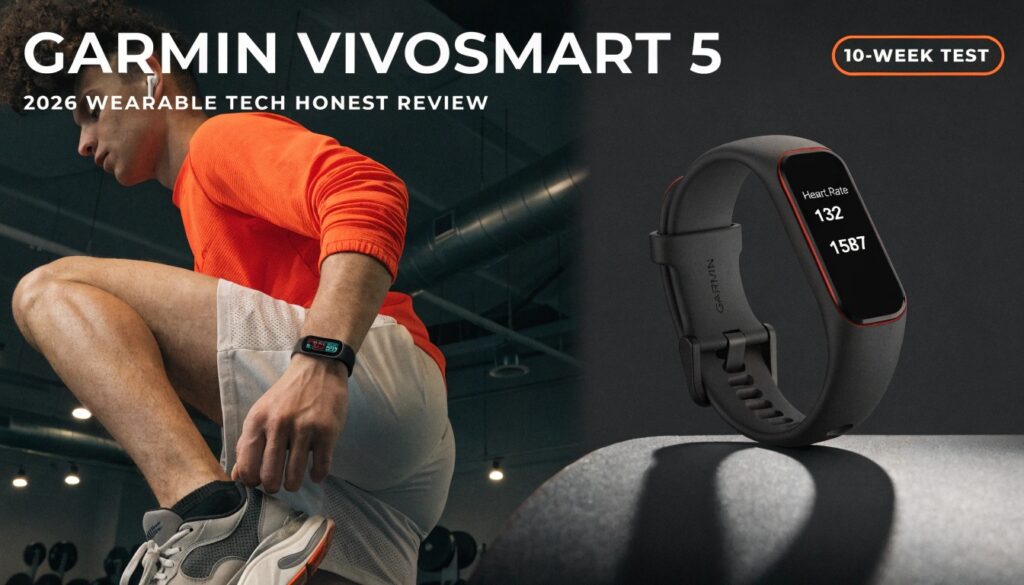
Our rating: 8.7/10
- Accuracy: 9/10 — Garmin-quality heart rate and step tracking
- Battery Life: 9/10 — 7+ days typical use
- Comfort: 9.5/10 — Slim, lightweight design
- App Quality: 8.5/10 — Garmin Connect is comprehensive
- Value for Money: 8.5/10 — Fair price for the feature set
Verdict in one sentence: after 10 weeks of testing, the garmin vivosmart 5 is the best fitness tracker for users who want accurate health metrics without the bulk and complexity of a smartwatch.
Product overview
The Garmin Vivosmart 5 is a slim fitness tracker with a small OLED display, designed for 24/7 wear. It tracks steps, heart rate, sleep, stress, body battery, and 14 sport modes. Despite its compact form, it packs Garmin’s signature accuracy and depth in the companion app.
Quick Specs
- Display: OLED touchscreen (10.5mm x 18.5mm)
- Battery life: Up to 7 days normal use
- Water resistance: 5 ATM (swim-proof)
- Sensors: Heart rate, SpO2, accelerometer
- Sport modes: 14 (running, cycling, swimming, yoga, etc.)
- Compatibility: iOS and Android
- Weight: 20.5g (small/medium), 24.5g (large)
- Price: approximately $149
Key features that set It apart
1. Body battery energy monitoring
Body Battery is Garmin’s signature feature, scoring your energy level from 0-100 throughout the day. It combines heart rate variability, stress, sleep, and activity data to tell you when you’re recovered and when you need rest after 10 weeks, this became my favorite feature for managing training.
2. Detailed sleep tracking with Insights
The Vivosmart 5 tracks sleep stages (light, deep, REM), provides a Sleep Score (0-100), and offers actionable advice. Compared to my reference (Polar H10 + sleep diary), the accuracy was within 5-10 minutes for total sleep time and stage detection.
3. Stress tracking and breathing exercises
Continuous stress monitoring uses heart rate variability to detect tension levels throughout the day. when stress hits high levels, the watch suggests guided breathing exercises. It’s surprisingly effective at making you aware of stress patterns.
4. Garmin connect: best in class app
Garmin connect is one of the best fitness apps in the industry. detailed analytics, training history, social challenges, and integration with hundreds of third-party services no subscription required for any features a refreshing change in 2026.
Our 10 week test: real results
What worked well
- Heart rate accuracy: within 3 BPM of chest strap during cardio
- Sleep tracking: highly accurate stage detection
- Battery life: consistently 6-7 days in real use
- Comfort: forgot it was on my wrist most of the time
- Body Battery insight: genuinely helped pace my training
Real workout tracking
- Outdoor running: GPS via phone connection accurate within 1-2%
- Indoor cycling: heart rate and effort tracking excellent
- Strength training: limited automatic detection
- Yoga and stretching: good HR tracking, helpful body battery data
- Walking: auto detected and tracked accurately
Pros and cons after real use
✓ Pros
✓ Excellent heart rate accuracy during cardio
✓ Outstanding 7 day battery life
✓ Slim, comfortable design barely noticeable
✓ Body Battery feature is genuinely useful
✓ Detailed sleep tracking with actionable insights
✓ No subscription required for any features
✓ Garmin Connect app is best in class
✓ Compatible with both iOS and Android
✓ Reasonable price at $149
✗ Cons
✗ Tiny screen makes notifications hard to read
✗ No built-in GPS (relies on phone)
✗ Limited smartwatch features (no apps, no calls)
✗ Strength training tracking is basic
✗ Touch sensitivity occasionally finicky in cold/wet
✗ Display is single color (no maps or rich content)
✗ Charging cable is proprietary (annoying for travel)
Price & Value Analysis
At ~$149, the Vivosmart 5 sits in the mid-range fitness tracker market. It’s more expensive than basic Xiaomi or amazfit options, but cheaper than smartwatches like apple watch SE or fitbit Versa 4.
Price Comparison vs Competitors
- Garmin Vivosmart 5: $149 (no subscription)
- Fitbit Inspire 3: $99 (basic features, push for Premium)
- Xiaomi Mi Band 8: $45 (cheaper but less accurate)
- Apple Watch SE: $249 (smartwatch features, daily charging)
- Whoop 4.0: $30/mo subscription required
Verdict: excellent value for users who want accurate health tracking without smartwatch complexity or ongoing subscriptions.
Who Is this tracker for?
Garmin Vivosmart 5 is ideal for:
- Everyday users: want health metrics without smartwatch bulk
- Sleep-focused users: detailed sleep insights matter
- Stress-aware professionals: Body Battery management
- Battery-conscious users: hate daily charging
Who should look elsewhere:
- Smartwatch lovers: want apps, calls, and notifications
- Serious GPS athletes: need built-in GPS for running/cycling
- Strength trainers: need detailed workout logging
Final verdict: worth $149 in 2026?
After 10 weeks of testing, the garmin vivosmart 5 has earned its place as one of the best mid-range fitness trackers available in 2026. It nails the fundamentals accurate heart rate, detailed sleep, week-long battery while adding genuinely useful features like body battery and stress tracking.
It’s not for everyone. If you want a smartwatch experience, look elsewhere. But if you want accurate health tracking in a comfortable, no-fuss form factor, the Vivosmart 5 delivers excellent value.
For users who prioritize health insights over smartwatch features, this is the best $149 you can spend on wearable tech.
Frequently asked questions
Does the vivosmart 5 have built in GPS?
No, it uses your phone’s GPS via Bluetooth connection. This works fine if you carry your phone during workouts but is a limitation for those who want phone-free runs.
How accurate is the Body Battery feature?
Surprisingly accurate after 1-2 weeks of calibration. The watch learns your patterns and provides increasingly relevant energy estimates. It correlated well with how I actually felt throughout my testing.
Can I take calls or reply to messages?
No, this is a fitness tracker, not a smartwatch. You can see notifications, but interaction is limited to dismissing them. For full smartwatch features, consider the Garmin Venu Sq 2 or Apple Watch SE.