Easy 15-minute morning routine for adults over 50: proven 2026 guide
Table of Contents
There’s a moment that happens to almost everyone past fifty, and almost nobody talks about. You sit on the edge of the bed for one extra second before standing up. Then two. Then five. You don’t notice it at first because the change is so small a beat here, a hesitation there but if you paid attention, you’d realize that the way you start your day has slowly, quietly, become harder than it used to be.

This isn’t a tragedy. It’s chemistry.
Your joints contain a fluid called synovium, and like most fluids, it gets viscous when nothing’s moving it. Eight hours of sleep is, biomechanically speaking, eight hours of stillness. By morning the fluid has thickened, the tissues have shortened, and your body is asking politely, but firmly for some warm-up time before it commits to being a person.
The fix is not coffee. The fix is movement, and the surprising thing is how little of it you actually need.
Why most people get this wrong
The instinct, when you’re stiff, is to wait. Have breakfast. Read the news, Hope it passes.
It does pass eventually, by mid-morning, you’ve usually forgotten about it. But here’s the catch: the daily cost of waiting compounds. You spend the first two or three hours of every day functioning at maybe 70% of your range, and over years, that becomes a habit your body stops fighting. The stiffness gets longer. The negotiation gets bigger. By sixty-five, “warming up” has become a full hour project.
The alternative takes fifteen minutes. Done daily, it doesn’t just shorten the morning negotiation it eventually erases it.
The routine
I want to manage expectations. This is not a workout. There’s no sweating, no straining, no point at which you’ll feel athletic The whole purpose is to be on your feet at 8 a.m. feeling like yourself, not like someone wrestling their own joints into cooperation.
Three parts. Five minutes each, No equipment, no clothes, nothing to buy though by Part 3 a good mat does help, and I’ll mention what I use.
Part 1: before standing up
Stay in bed. Honestly. The first chunk happens horizontal, which is a small mercy.
Ankle circles. Ten in each direction, both feet The motion is small. Don’t be fooled by how minor it feels the warmth that creeps up your calves within thirty seconds is your circulation responding, and that’s the entire point.
Knee draws. One leg at a time, pull the knee gently toward your chest. Hold a slow count of ten. Five rounds per side. Don’t force range. Whatever distance the knee wants to give you on day one is exactly the right distance.
Open and close your hands. Slowly, deliberately. Then circle your wrists. The first stiff thing most people meet in the morning is a coffee lid or a button on a shirt. Thirty seconds here removes that small daily defeat.
The lower-back rock. Bring both knees to your chest and rock side to side for two minutes. Treat it less as exercise and more as a quiet conversation with your spine letting it know the day is going to be reasonable.
Part 2 : on your feet
Now stand up, Slowly.
Shoulder circles. Big, slow, ten forward and ten back. We carry more tension in the shoulders than we realize, especially side-sleepers. This unwinds it.
Marching in place. Two minutes. It feels silly. Do it while the kettle heats the practical excuse helps. The point isn’t the marching, it’s the alternating weight shift, which wakes the hips in a way few simple movements can.
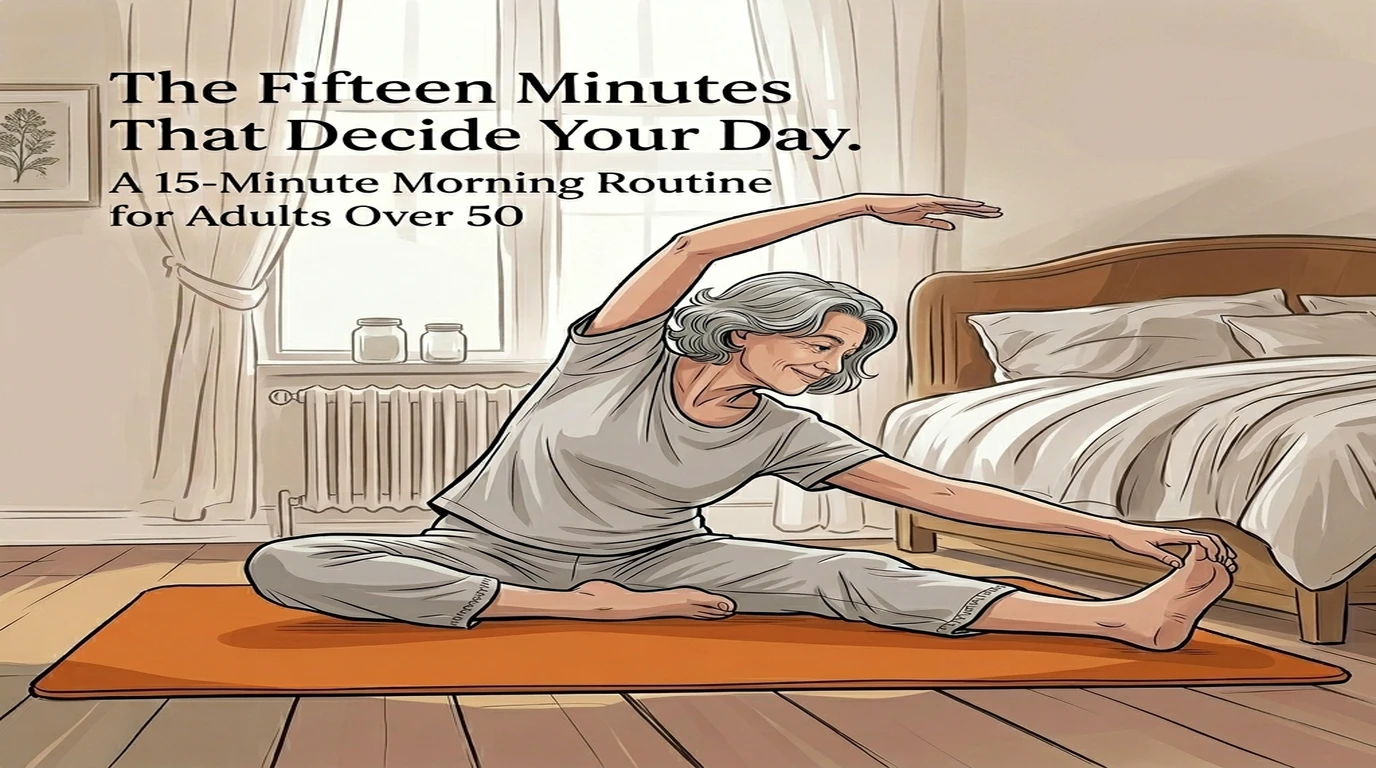
Side bends. Feet shoulder-width apart. One hand slides down the outside of the thigh while the opposite arm reaches overhead. Alternate sides slowly. Most of us spend our lives facing forward; this reminds the torso that lateral motion exists.
Half-squats with support. Hold the back of a chair. Lower yourself halfway down and only halfway then come back up. Five reps to start. Pace matters more than depth, and depth doesn’t matter very much. If you want to progress this over time, a light pair of resistance bands looped around the thighs adds gentle resistance without straining the knees.
Neck tilts. Toward one shoulder, hold five seconds, return, then the other side. That is the entire exercise. Skip the full neck rolls. Most physiotherapists will tell you to avoid them past fifty the small benefit is not worth what they ask of the cervical spine.
Part 3 : finish
Cat-cow. On a mat, on all fours. Arch the back, look up. Round the back, drop the head. Slowly, for two minutes. If you do exactly one thing from this article, do this. The effect on spinal mobility is genuinely disproportionate to how trivial the movement looks.
A note on the mat itself: for floor work past fifty, thickness matters more than you’d think. A standard 4mm yoga mat leaves your knees and wrists pressing into hard floor. I keep a Gaiam 6mm Premium mat by the bed the extra cushion under kneeling positions is the difference between a routine you keep doing and one you quietly drop. If your floors are particularly hard, the HemingWeigh half-inch mat is thicker still and a popular pick for people with arthritic knees.
Breathing. Four counts in through the nose, hold two, six counts out through the mouth. Five rounds. Yes, this sounds like it belongs in a different kind of article. It’s here for a specific reason: controlled exhalation activates the part of your nervous system that lowers inflammation. You don’t have to believe it. Try it for two weeks.
What happens
The first three days, this will feel like a chore, That’s the universal experience and there’s no way around it. Push through.
Around day eight or nine, something shifts. You’ll notice you’re getting out of bed faster. Not dramatically just a beat sooner. You won’t even register the moment it happens.
By week three, the routine stops feeling like something you do and starts feeling like something you simply are doing. Like brushing your teeth. Boring. Reliable. Quietly transforming the rest of your morning.
If you have a clinical diagnosis osteoarthritis, rheumatoid arthritis show this list to your physiotherapist before you start. Not because it’s risky, but because they can spot in five minutes which two or three movements to modify for you. That conversation is worth having.
If you’d like to pair this morning routine with something for the rest of the day, our balance training routine for adults over 50 fits naturally on top of it fifteen minutes in the morning, eight minutes later in the day, and you’ve covered most of what your joints actually need. And if you’ve been wondering whether lifting weights at home could fit into your routine at this stage of life, that’s worth a read too it addresses exactly the hesitations most people have past fifty.
The quiet argument
Past fifty, fitness changes meaning. It stops being about how you look and starts being about how much friction stands between you and the day you wanted to have. Fifteen minutes of mostly-trivial movement is the smallest possible investment that meaningfully reduces that friction.
That’s the whole pitch. There’s no transformation here, no reinvention, no version of you that’s twenty years younger. There’s just a slightly easier morning, Done daily, that small ease becomes the texture of how you live.
That’s enough. It’s actually quite a lot.
________________________________________
FitSmartHealth — Smart choices for pure living. Informational only; check with your doctor about any new routine if you have musculoskeletal concerns.