Apple Watch SE vs Fitbit Versa 4: Which Is Better for Fitness in 2026?
Apple Watch SE vs Fitbit Versa 4. Two watches. Two philosophies. One $300 decision you really don’t want to get wrong.

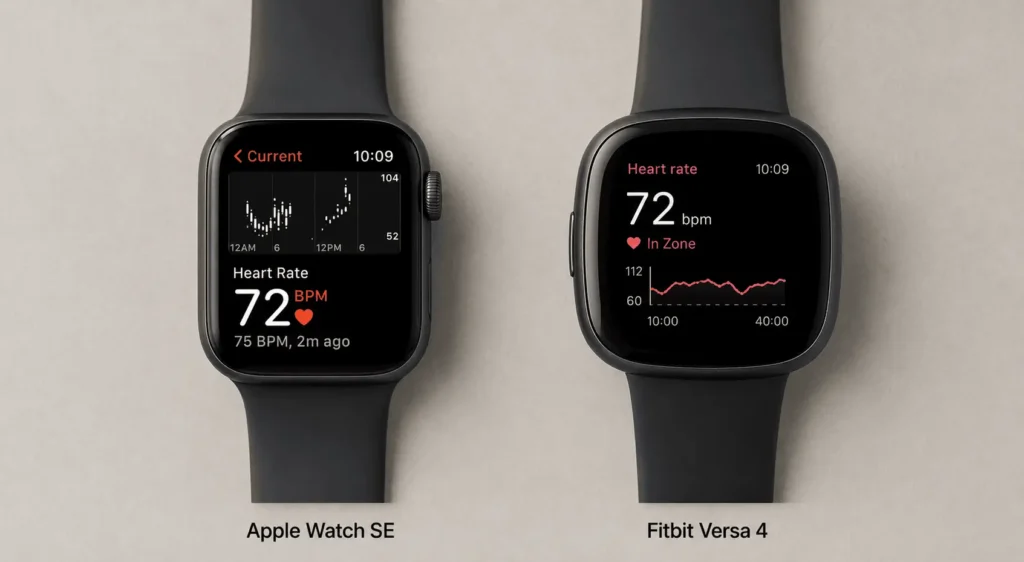
The Apple Watch SE and the Fitbit Versa 4 sit in roughly the same price tier and both promise solid fitness tracking with smartwatch features. But they’re built for completely different people. Pick wrong and you’ll spend the next two years frustrated – battery life that doesn’t match your lifestyle, ecosystem you can’t actually use, features you paid for but never touch.
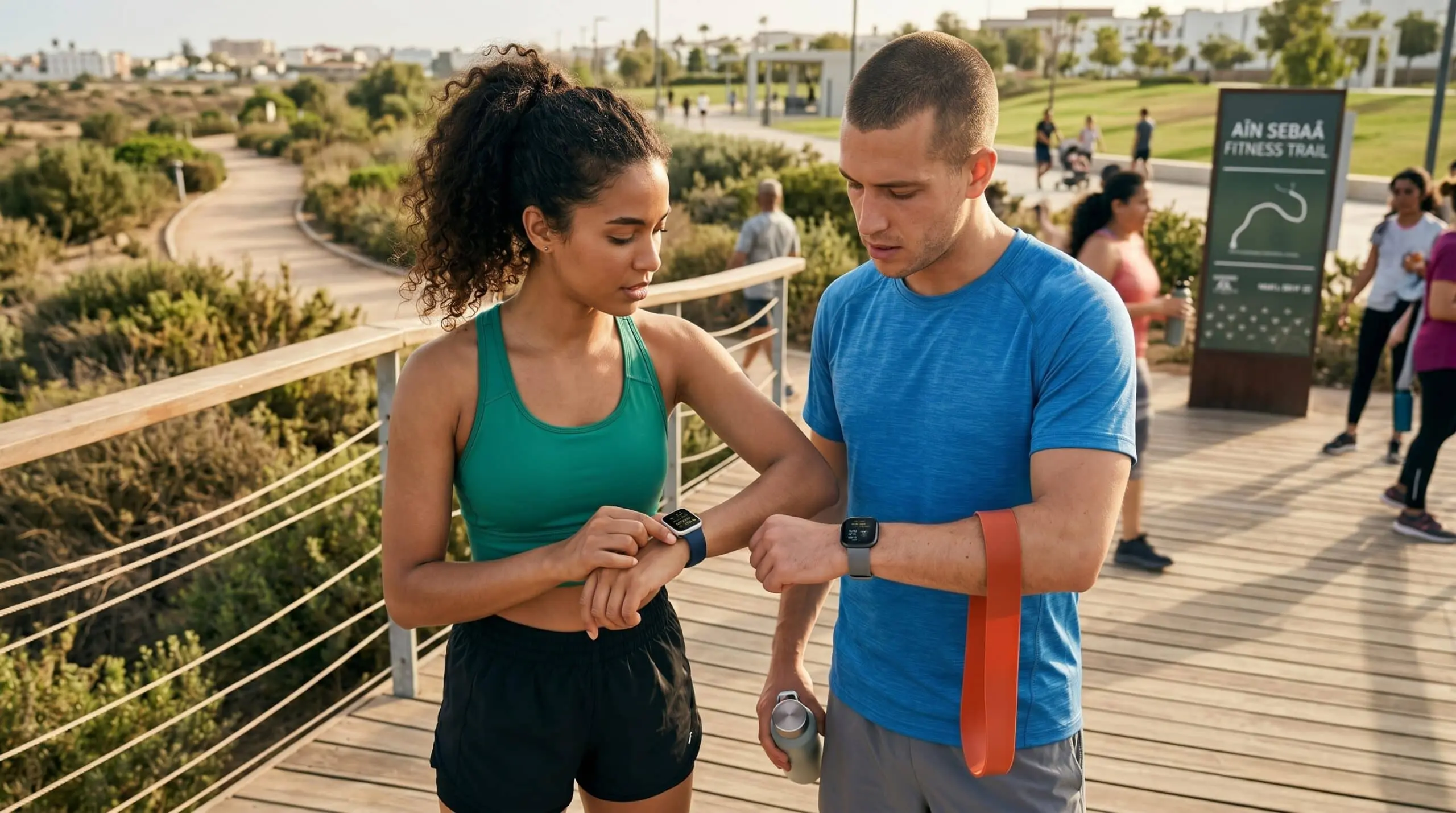
I wore both watches simultaneously for 8 weeks. Left wrist Apple, right wrist Fitbit. Same workouts, same sleep schedule, same daily life. I cross-checked heart rate against a Polar H10 chest strap, ran the same 5K route six times to test GPS, and compared sleep data side by side every morning.
This is what I actually found – the parts where one wins decisively, the parts where they’re closer than the marketing suggests, and the three questions that should determine your choice in under a minute.
If you want the broader picture across all major brands first, our best fitness tracker 2026 guide covers Apple, Fitbit, Garmin, Whoop, and Xiaomi in one place. If you’ve already narrowed it down to these two, keep reading.
Quick Verdict: Skip Ahead If You’re in a Hurry
Apple Watch SE wins if you have an iPhone and want a real smartwatch. End of story.
Fitbit Versa 4 wins if you’re on Android, you hate daily charging, or sleep tracking is your top priority.
If neither of those describes you, scroll to the 3-question decision framework at the end. It’ll give you an answer in 90 seconds.
Quick Comparison: At a Glance
| Feature | Apple Watch SE | Fitbit Versa 4 |
|---|---|---|
| Price | ~$249 | ~$199 |
| Battery life | 18 hours | 6+ days |
| Compatibility | iPhone only | iOS + Android |
| Heart rate accuracy | Excellent | Excellent |
| GPS accuracy | Good | Slightly better |
| Sleep tracking | Basic | Best-in-class |
| Smartwatch features | Class-leading | Limited |
| Subscription required | None | Premium $9.99/mo (optional) |
| Workout types | 30+ | 40+ |
| Water resistance | 50m | 50m |
The Two Watches at a Glance
Apple Watch SE – The Premium Smartwatch With a Fitness Side
The Apple Watch SE is Apple’s entry-level smartwatch. Same S8 chip as the more expensive models, just stripped of ECG, blood oxygen, and the always-on display.
It’s a smartwatch first, a fitness tracker second. That order matters more than the spec sheet suggests.
Quick specs:
- Display: Retina LTPO OLED, 1000 nits
- Battery: ~18 hours typical use
- Water resistance: 50m (swim-proof)
- Sensors: Heart rate, accelerometer, gyroscope, GPS, compass
- Workout types: 30+ with auto-detection for major activities
- Compatibility: iPhone 6s or later only
- Price: From $249 (40mm GPS)
Fitbit Versa 4 — The Fitness Watch That Happens to Be Smart
The Fitbit Versa 4 (affiliate link placeholder) takes the opposite approach. It’s a fitness device that picked up some smartwatch features on the way.
Sleep tracking, multi-day battery, and Android compatibility are the headline pitches. The smartwatch side – notifications, basic apps, voice assistant – works fine but never feels like the main event.
Quick specs:
- Display: AMOLED with always-on option
- Battery: 6+ days typical use
- Water resistance: 50m (swim-proof)
- Sensors: Heart rate, SpO2, accelerometer, GPS, gyroscope
- Workout types: 40+ pre-loaded
- Compatibility: iOS 15+ and Android 9+
- Price: From $199
Head to Head: 6 Categories That Actually Matter
1. Heart rate accuracy
Both watches were tested against a Polar H10 chest strap across roughly 35 workouts: easy runs, intervals, cycling, yoga, and a few strength sessions.
Steady-state cardio: both stayed within 2 BPM of the chest strap. Indistinguishable in real-world use.
HIIT and intervals: the Apple Watch SE had a slight edge — 3-5 seconds faster to catch heart rate spikes, and recovery readings caught up to the chest strap quicker. We’re talking small margins, but consistent across sessions.
Strength training: both struggled. This isn’t a watch problem — it’s a wrist-based optical sensor problem. Every device on the market has the same limitation here.
Resting heart rate: identical between the two devices.
Winner: Apple Watch SE, by a small margin. For most users, the difference won’t matter.
2. GPS accuracy
I ran the same 5K route six times with both watches.
The Apple Watch SE consistently came in short – readings between 4.85K and 4.97K on a known 5K route. That’s not a deal-breaker for casual use, but if you’re tracking pace seriously, those gaps add up.
The Fitbit Versa 4 hit closer to truth, with readings between 4.95K and 5.02K. Not perfect, but more reliable.
Winner: Fitbit Versa 4. A surprise result, honestly – Apple usually leads here. The Versa 4’s connected GPS implementation has gotten quietly better over the past two years.
3. Battery life
This isn’t a contest.
The Apple Watch SE needs charging every single day. 18 hours of typical use, less if you do a tracked workout with GPS. You will charge this watch every night, full stop.
The Fitbit Versa 4 hit 5-6 days routinely in my testing, even with daily workouts, continuous heart rate monitoring, and notifications enabled. I charged it twice a week on a Sunday morning and didn’t think about it otherwise.
This isn’t just a convenience thing. Daily charging means missed nights of sleep tracking – which is exactly the data most people bought the watch for.
Winner: Fitbit Versa 4. Decisively. This is the single biggest practical difference between the two watches, and the one most reviews underweight.
4. Sleep tracking
Fitbit pioneered modern sleep tracking and they’ve spent a decade refining it. It shows.
The Versa 4 gives you detailed sleep stages — light, deep, REM — a Sleep Score from 0 to 100, and contextual insights that actually correlate with how you feel. Personalized advice. Long-term sleep pattern analysis. The sleep profile feature, which categorizes your sleep type after 30 days of data, is genuinely interesting.
Apple has improved a lot here over the past three years, but it still trails. Apple Watch SE shows you total sleep, stages, and a basic chart. That’s about it. Useful, but you’ll notice the depth gap if you came from Fitbit.
Winner: Fitbit Versa 4. By a wide margin. If sleep is why you’re buying the watch, this is the decisive category.
5. Smartwatch features
If you have an iPhone, the Apple Watch SE is in a different league.
iMessage replies that actually work. Apple Pay across every store you visit. Siri integration that does what you ask. Third-party apps – Spotify offline, Strava, Headspace, you name it. Notifications that feel native because they are native. The ecosystem integration with your iPhone, AirPods, and Mac is the kind of thing you don’t notice until you don’t have it.
The Fitbit Versa 4 (affiliate link placeholder) shows notifications, supports quick replies on Android (not iOS), runs Alexa or Google Assistant, and has Fitbit Pay in select countries. It works. It just feels generations behind the Apple experience.
Winner: Apple Watch SE. Decisively, but only if you have an iPhone. For Android users, this category doesn’t apply – the SE simply won’t pair with your phone.
6. Workout variety and coaching
Both watches cover the major workout types and detect activities automatically.
Apple Watch SE supports 30+ workout types, with strong auto-detection for running, cycling, walking, and elliptical. The integration with Apple Fitness+ (a $9.99/month subscription) gives you guided video workouts that sync metrics to your TV or phone screen – genuinely good if you’ll use it.
Fitbit Versa 4 supports 40+ workout types and includes guided workouts through Fitbit Premium (also $9.99/month). The Versa 4’s coaching is more focused on adaptive workouts and recovery insights than Apple Fitness+’s video-led approach.
Winner: Tied. Apple is more polished, Fitbit has more workout variety. Both gate the best coaching features behind a subscription you don’t strictly need.
The 3-Question Decision Framework
If you’ve made it this far and still aren’t sure, these three questions narrow it down in 90 seconds.
Question 1: What phone do you have?
- iPhone, will never switch? Get the Apple Watch SE. The ecosystem integration alone justifies the daily charging. Check current Apple Watch SE price.
- Android phone? Get the Fitbit Versa 4. The Apple Watch SE physically does not work with Android. There is no debate here.
- Switch between iPhone and Android? Versa 4. Flexibility wins.
Question 2: How much do you care about sleep tracking?
- A lot – it’s why I want a watch. Versa 4. The depth of insights, the Sleep Score that actually correlates with how you feel, the long-term pattern analysis – it’s the best in the category.
- Casual interest. Either works. Apple Watch SE will show you the basics; Versa 4 will give you more, but you might not use it.
Question 3: Can you charge daily without missing it?
- Yes, no problem. Apple Watch SE is still in play.
- Honestly, no. Versa 4. Don’t fight the friction. A watch that comes off before bed every night because it needs charging is a watch that misses 30+ nights of sleep data per year.
The Verdict
For iPhone users: Apple Watch SE. The ecosystem integration is unmatched, the smartwatch features actually work for daily life, and the fitness tracking has gotten genuinely competitive over the last three generations. The daily charging is real friction, but for most iPhone users, the tradeoff is worth it. You can check the current price on Amazon – Apple holds MSRP firm, but third-party sellers occasionally discount it.
For Android users: Fitbit Versa 4 is the only choice that matters here. Apple Watch SE doesn’t work with Android, period. The Versa 4 is also the better pick if you specifically care about sleep tracking, hate daily charging, or want to spend $50 less. You can grab the Versa 4 on Amazon, where it occasionally drops below $180 during sales.
For most other situations: the question isn’t really which watch is better – it’s which one fits your life better. The Apple Watch SE is the more impressive piece of technology. The Fitbit Versa 4 is the more practical one.
If you’re still genuinely undecided, our Garmin Vivosmart 5 review covers a third option that often outperforms both for users who want pure fitness tracking without the smartwatch overhead. And for the wider context of how these watches fit into a complete health setup, the health and fitness technology pillar guide is the right next read.
Frequently Asked Questions
Can the Apple Watch SE work with Android phones?
No. The Apple Watch SE requires an iPhone 6s or later running a recent version of iOS. It will not pair with Android phones, period. If you’re on Android, the Fitbit Versa 4 is the comparable option.
Which watch has better battery life – Apple Watch SE or Fitbit Versa 4?
Fitbit Versa 4 wins decisively. The Versa 4 lasts 5-6 days on a single charge with normal use, while the Apple Watch SE typically lasts about 18 hours and requires daily charging. If battery life is a priority, the Versa 4 is the clear winner.
Is the Apple Watch SE good for fitness tracking?
Yes, the Apple Watch SE is a strong fitness tracker – heart rate accuracy is excellent, workout detection is reliable, and the integration with iPhone is seamless. However, it’s not as deep on sleep tracking as the Fitbit Versa 4, and the 18-hour battery limits 24/7 wear for sleep monitoring.
Do I need Fitbit Premium to use the Versa 4?
No. All core features – heart rate, GPS, sleep stage detection, workout tracking – work without a subscription. Fitbit Premium ($9.99/month) unlocks advanced sleep insights, guided workouts, and the Daily Readiness Score, but it’s optional.
Which is better for sleep tracking?
Fitbit Versa 4, decisively. Fitbit has been refining sleep tracking for over a decade, and the Versa 4 offers detailed sleep stages, a Sleep Score, personalized insights, and long-term pattern analysis that the Apple Watch SE doesn’t match.
Is the Apple Watch SE worth $50 more than the Fitbit Versa 4?
For iPhone users, yes – the ecosystem integration, app library, and smartwatch features justify the price difference. For Android users, the question is moot since the Apple Watch SE doesn’t work with Android phones.