Resistance bands buying guide 2026: choose the best
Table of Contents
Resistance bands have exploded in popularity since 2020, and the market is now flooded with options ranging from $10 throwaways to $200 professional sets. With dozens of brands, multiple types, and confusing resistance levels, it’s nearly impossible for a beginner to know what to actually buy.

We’ve tested over 15 different resistance band sets over the past two years. Some snapped within weeks. Others have lasted through hundreds of workouts. This guide cuts through the marketing fluff to give you exactly what you need to make a smart purchase.
By the end of this article, you’ll know exactly which type of bands fit your goals, what features matter, and which brands deliver real value.
Why resistance bands are worth buying
Before diving into types and features, let’s address the obvious: are resistance bands actually effective? The answer is yes, with caveats. Studies in 2024 confirmed that band-only training produces 85-90% of the muscle gains compared to free weights when applied with proper progressive overload.
More importantly, bands offer benefits that dumbbells simply can’t match: they’re space-efficient, travel-friendly, joint-protective, and dramatically cheaper. For most home gym users, they’re the highest-ROI fitness purchase you can make.
The 4 main types of resistance bands
1. Tube bands with handles
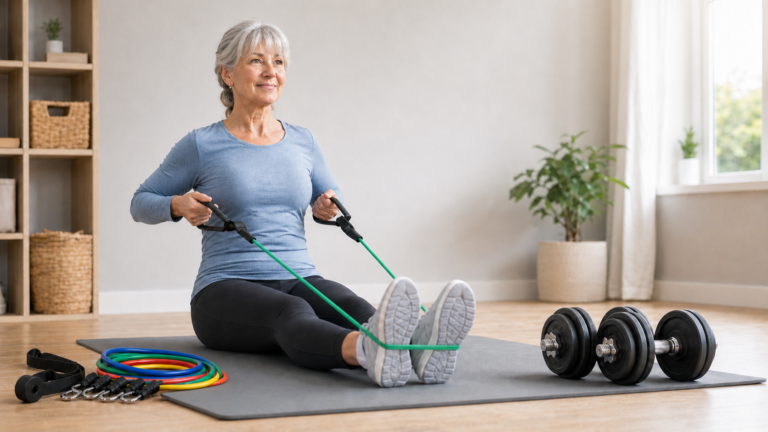
The most versatile type. Tube bands have rigid plastic handles attached and often come with door anchors and ankle straps. They mimic cable machine exercises and work for full-body workouts.
Best for: General home workouts, full-body training, beginners and intermediates
2. Loop bands (mini bands)
Small fabric or rubber loops, typically 12 inches around. Designed for hip and glute work, lateral movements, and rehabilitation. Often sold in sets of 3-5 different resistance levels.
Best for: Glute training, warm-ups, rehabilitation, lateral movement work
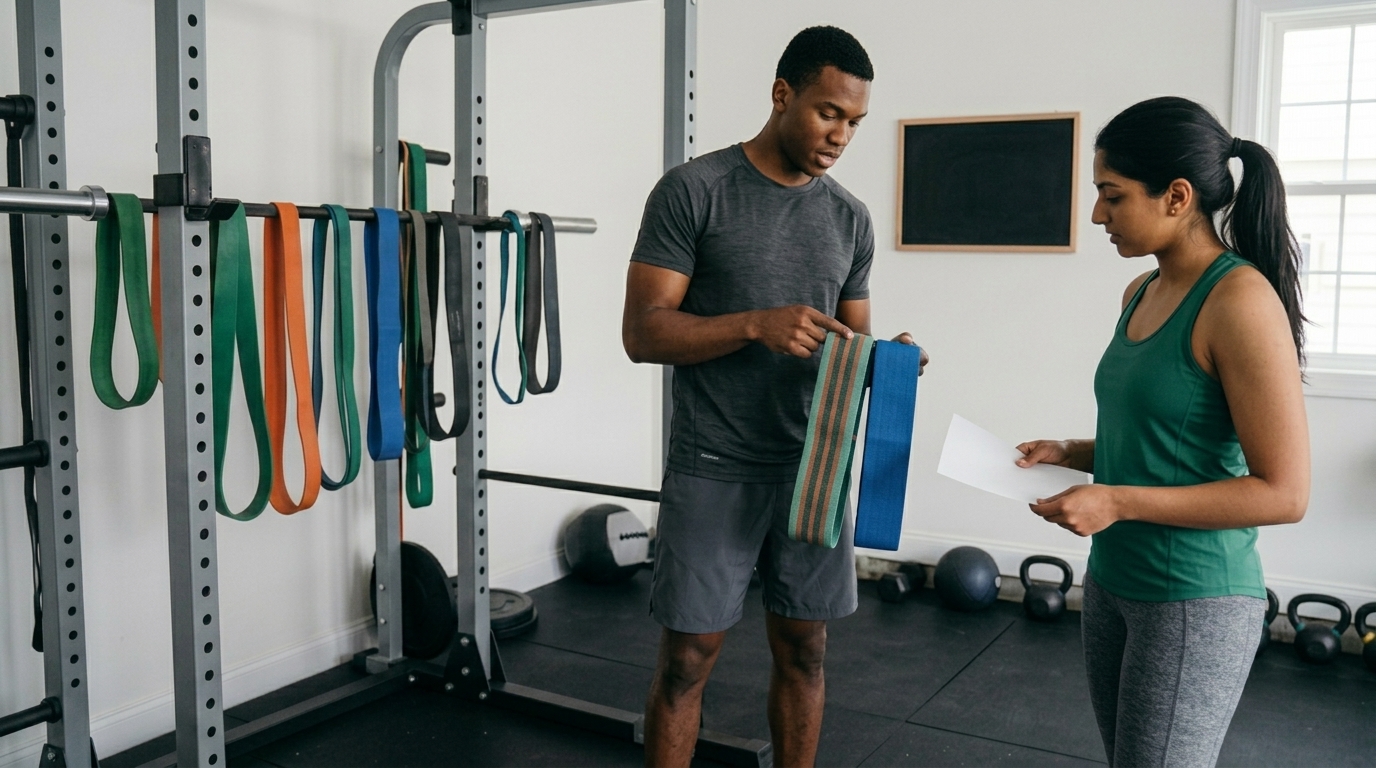
3. Power bands (long loops)
Long, continuous loops of varying widths. Wider bands provide more resistance. Used for pull-up assistance, mobility work, and serious strength training.
Best for: Pull-up training, mobility, advanced strength training
4. Therapy bands (flat bands)
Flat sheets of latex or rubber, typically 4-6 feet long. Lower resistance than tube bands, designed primarily for physical therapy and gentle exercise.
Best for: Physical therapy, rehabilitation, beginners with mobility limitations
What to look for when buying
1. Material quality
The two main materials are natural latex and synthetic rubber. Latex provides better elasticity and snap-back, but some users have allergies. Synthetic rubber is more durable but may feel less responsive. For most users, latex from reputable brands offers the best performance.
Avoid: Cheap PVC or plastic bands. They lose elasticity quickly and feel awful.
2. Resistance range and stackability
Quality sets include multiple resistance levels (typically 5-7 bands). The crucial feature is ‘stackability’the ability to combine multiple bands for greater resistance. This is how you achieve progressive overload as you get stronger.
- Beginner sets: 10-30 lbs total resistance per band
- Intermediate sets: 5-50 lbs per band, stackable to 100+ lbs
- Advanced sets: 5-100+ lbs per band, stackable to 300+ lbs
3. Anti-snap construction
Quality bands include anti-snap features typically a fabric sleeve or cable inside the rubber. If a band breaks during use, the cable prevents whip-back injury. This is critical for safety.
Safety warning: Never buy resistance bands without anti-snap protection, especially for chest, shoulder, or face-level exercises. A snapping band can cause serious injury.
4. Handle quality
If buying tube bands, examine the handles. Quality handles have:
- Comfortable foam grips: No sharp edges or seams
- Strong reinforced clips: Won’t pop off mid-rep
- Sturdy connection point: Welded or reinforced where band meets handle
5. Included accessories
Look for sets that include:
- Door anchor: Enables back, shoulder, and chest exercises
- Ankle straps: For leg exercises and kickbacks
- Carrying bag: Keeps everything organized
- Workout guide: Helpful for beginners
Common beginner mistakes
Mistake 1: buying the cheapest set
$15 Amazon specials seem like great deals, but they typically last 2-3 months before snapping or losing elasticity. Quality bands last 1-3+ years. The cheap sets cost more in the long run and pose injury risks.
Mistake 2: choosing bands without anti-snap
Cheap bands without internal cables can snap unexpectedly, causing injuries to face, eyes, or hands. The $20-30 difference for safety features is non-negotiable.
Mistake 3: underestimating needed resistance
Beginners often buy ‘beginner’ kits with maximum 30 lbs resistance, then outgrow them within 2-3 months. Buy a stackable system with at least 100 lbs total combined resistance from the start.
Mistake 4: ignoring door anchor quality
Cheap door anchors can fail under heavy load, causing the band to whip back. Look for door anchors with thick, padded foam and reinforced stitching.
Our top resistance band recommendations
Best overall: bodylastics stackable tube bands
Bodylastics offers the gold standard in stackable tube bands. Anti-snap technology, lifetime guarantee, and stackable up to 142 lbs of resistance. Trusted by Navy SEALs and serious athletes.
Best budget: fit simplify loop bands
If you want loop bands for glute work, mobility, or rehab, the Fit Simplify set is perfectly adequate. 5 different resistance levels in a compact set. Great for adding to existing equipment.
Best power bands: rogue echo resistance bands
For pull-up assistance, mobility work, or serious strength training, Rogue Echo bands are commercial-grade quality. Available in widths from 1/2′ to 2.5+’, covering 5-200+ lbs of resistance.
Best premium set: TRX functional training tools
TRX offers exceptional quality for those willing to spend $150+. Their resistance band system integrates perfectly with their suspension trainers for advanced functional training.
How to use your resistance bands effectively
Progressive overload with bands
Just like with weights, you need to progressively challenge yourself. With bands, you can:
- Stack multiple bands: Combine for greater total resistance
- Shorten the band: Stand on more of it for increased tension
- Increase reps and sets: Volume progression
- Slow down the eccentric: 3-second negatives multiply intensity
- Pause at peak contraction: Hold for 2-3 seconds for time-under-tension
Care and maintenance
- Store away from sunlight: UV degrades latex over time
- Inspect before each workout: Look for cracks, tears, or thin spots
- Avoid extreme temperatures: Heat softens, cold makes brittle
- Keep clean and dry: Wipe down with damp cloth after use
The bottom line: what to buy
If you’re confused after all this, here’s the simplest path:
- Beginner home workouts: Bodylastics Stackable Tube Bands ($99)
- Glute and hip work: Fit Simplify Loop Bands ($15)
- Pull-up assistance: Rogue Echo Power Bands ($15-50 per band)
- Serious training: Combine Bodylastics + Rogue power bands
Don’t overthink this. Even the ‘best’ resistance bands cost less than 2 months of gym membership. Buy quality once and you’re set for years.
Comparing options? Read our resistance bands vs dumbbells comparison.
Need dumbbells too? See our bowflex selecttech 552 review.
Frequently asked questions
How often should I replace resistance bands?
Quality bands last 1-3 years with regular use. Replace immediately if you notice cracks, tears, or thin spots never use damaged bands. Cheap bands may need replacement every 3-6 months.
Can I use resistance bands daily?
Yes, but apply the same recovery principles as with weights. Train each muscle group 2-3 times per week with rest days between intense sessions. Daily light band work is fine for mobility and warm-ups.
Do resistance bands work for building muscle?
Yes. Studies confirm bands produce 85-90% of muscle gains compared to free weights when applied with progressive overload. They’re effective tools, not just rehab equipment