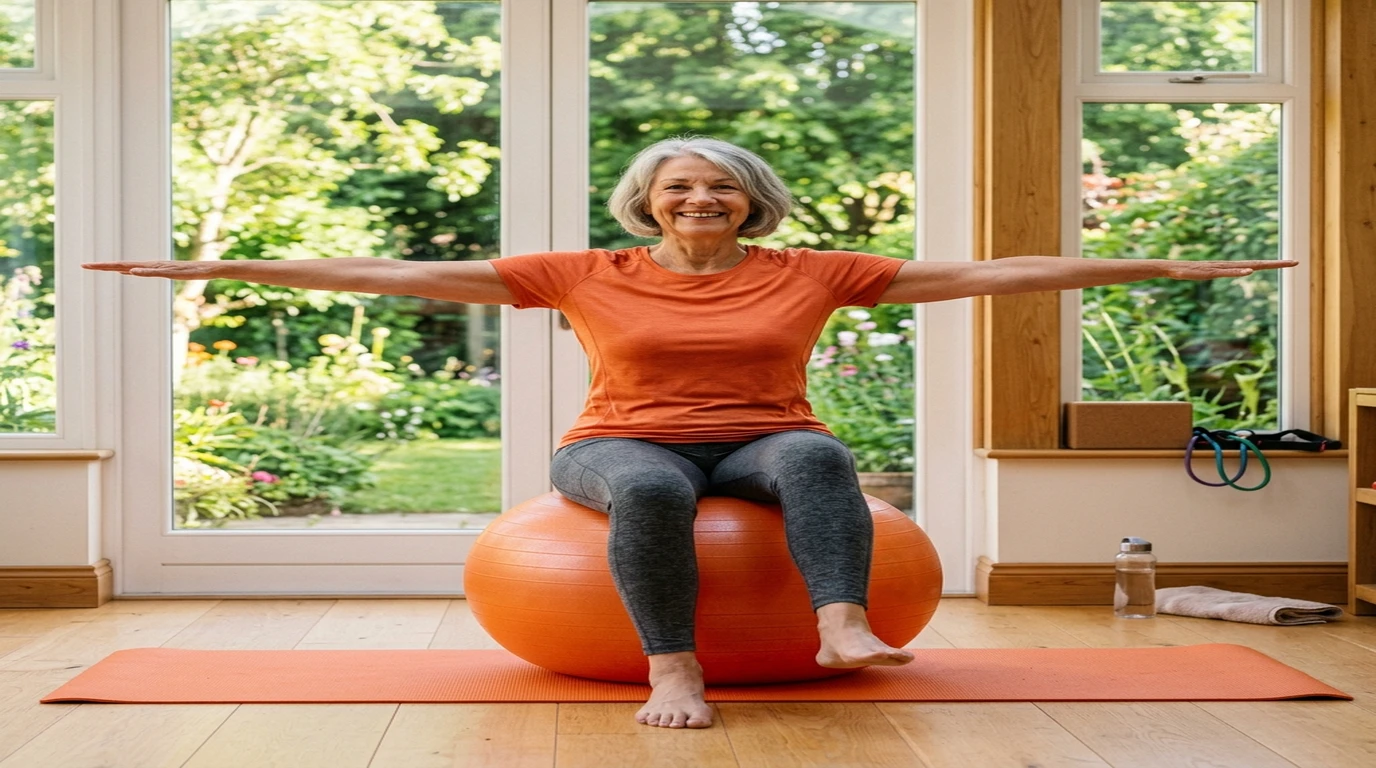
balance training:
Table of contents
The most important workout you’re probably not doing:
A physiotherapist I know she specializes in balance training for older adults once told me that she can predict, with about 80% accuracy, which of her patients will spend their last years independent and which won’t. The test takes ninety seconds. She has them stand on one leg.

“Thirty seconds, no wobble, eyes open,” she said. “If they can do that, they’re usually fine. Below ten, I start having difficult conversations with their families.”
I think about that conversation often, because it cuts against almost everything we’re told about staying healthy as we age. We hear about heart health, blood pressure, cholesterol, weight. We hear about cardio and strength. We almost never hear about balance and yet balance, as it turns out, may be the single most consequential piece of physical fitness past sixty.
This article is about why balance training matters so much, and what to do about it.
The conversation cobody wants to have
Falls are the leading cause of injury-related death in adults over 65 in most developed countries. Not heart attacks. Not strokes. Falls.
The numbers, when you actually look at them, are alarming. According to the CDC’s older adult fall data, about one in four adults over 65 falls every year. Roughly 20% of those falls cause serious injury broken hips, head trauma, fractures that change everything. The five-year mortality rate after a hip fracture in older adults sits somewhere around 50%.
These are not statistics most of us want to dwell on. They certainly weren’t part of the conversation when I started thinking seriously about my own fitness in my late forties. But understanding them changed how I think about exercise entirely. The most important question isn’t “how long can I run?” or “how much can I lift?” it’s “if my foot catches on the rug at 2 a.m., am I going to catch myself, or am I going to break something?”
Balance training is the answer to that question. And balance training, almost uniquely among forms of exercise, is something that very few people over fifty actually do.
What balance actually Is
Most people think of balance as one ability. It isn’t. It’s the cooperation of three separate systems, all of which decline with age unless you actively maintain them.
The vestibular system those tiny fluid-filled chambers in your inner ear tells your brain which way is up. The visual system orients you in space relative to fixed reference points. And proprioception, perhaps the most underrated of the three, is the constant stream of nerve signals from your feet, ankles, knees, hips, and spine telling your brain exactly where every part of your body is, without you needing to look.
These three systems work together so seamlessly when they’re functioning that you don’t notice them. You only notice when one of them slips. The dizziness when you stand up too fast that’s vestibular. The wobble when you close your eyes in the shower that’s visual dependence. The strange unsteadiness on uneven ground that’s proprioceptive.
The good news, well-established in the literature now, is that all three systems respond remarkably well to balance training, even into very late life. The brain rewires itself based on what you ask it to do. Stop asking, and it slowly stops giving.
The bad news is the inverse: if you don’t actively challenge balance, you lose it. There is no neutral state. You’re either improving or eroding.
What the research says about balance training
Decades of falls-prevention research most of it conducted in geriatric clinics in places like Australia, the UK, and the Netherlands has converged on a remarkably consistent picture of what actually reduces falls. The interventions that work, work for similar reasons, and most of them are surprisingly mundane.
The CDC’s STEADI initiative and programs like the Otago Exercise Programme, developed in New Zealand, are among the most studied balance training interventions. It’s not exotic. It’s a set of strength and balance exercises, done at home, three times a week. Trial after trial has found that adults who do something like Otago have measurably fewer falls often 30% to 40% fewer than those who don’t.
Tai chi has similar evidence behind it, particularly for adults over 70. The slow, weight-shifting movements train all three balance systems at once, and the social component (most people do it in classes) seems to add adherence benefits that solo programs lack.
What both approaches share is the principle that effective balance training requires gentle, controlled instability. You have to challenge your balance make it work slightly harder than it’s used to without putting yourself at actual risk of falling. That’s the sweet spot, and it’s surprisingly easy to find at home.
A practical balance training routine
You can build a competent balance training practice in five to eight minutes a day.The exercises below are derived from established falls-prevention programs like the NHS balance exercises for older adults, scaled for someone working alone at home.
Single-leg standing. Near a counter or sturdy chair (so you have something to grab if needed), lift one foot a few inches off the floor. The goal is to hold the position for thirty seconds without touching down. Most people, when they first try this, are surprised. If you can manage ten seconds on each leg, you’re starting from a reasonable place. If you can’t manage three, that’s important information start there, and progress will come quickly.
When thirty seconds becomes easy, the next progression is to do it with eyes closed. This removes visual input and forces the vestibular and proprioceptive systems to work harder. It’s significantly more difficult than it sounds.
Tandem walking. Walk in a straight line, placing the heel of one foot directly in front of the toes of the other. Twenty steps forward, twenty back. This targets the small stabilizing muscles around the ankle and foot muscles most adults haven’t asked anything of in years.
Weight shifts. Stand with feet shoulder-width apart. Slowly shift all your weight onto your right leg, hold for a few seconds, then to your left. Repeat ten times. Trivial-seeming, but it’s training the system that prevents you from over-correcting when you stumble.
Heel raises. Stand near a wall or counter. Rise onto your toes, hold for a beat, lower slowly. Ten to fifteen reps. This builds calf strength, which is one of the strongest predictors of fall risk in older adults.
Walking with head turns. While walking, deliberately turn your head left and right every few steps. Look up at the ceiling, then down at the floor. Most older adults unconsciously stop doing this they keep their head locked forward to avoid the small dizziness that comes with movement, and the vestibular system atrophies as a result. Fighting that habit is the single most useful thing you can do for your inner ear.
Five exercises, eight minutes total if you do them all. Done daily, the cumulative effect of this balance training is significant. Done three times a week, still meaningful.
What changes when you start balance training
Most people who begin balance training notice the first changes within ten to fourteen days. Single-leg standing time roughly doubles in the first month for previously sedentary adults. Stairs feel different. Standing on one foot to put on shoes stops being a small adventure.
The bigger changes are slower and harder to see. Falls risk reductions show up in study data over six to twelve months, not weeks. The whole point of this work is invisible insurance you don’t notice the falls you didn’t have. The wet floor you crossed without slipping. The cobblestone you wouldn’t have caught your toe on. The loose rug.
Which is, perhaps, the strangest thing about balance training. The more successfully you do it, the less obvious the benefit becomes. It’s the absence of falls, not the presence of strength, and absence is hard to celebrate.
The quiet case for balance training after sixty
Past sixty, the meaning of fitness shifts. It stops being about looking different or feeling athletic and starts being about something more basic: staying yourself, in your own home, doing your own things, for as long as you can.
Balance training is the unsexy backbone of that goal. It doesn’t get the magazine covers. It doesn’t get the apps and the Instagram following. It gets relegated to a footnote in fitness articles aimed at older adults, when it should be the headline.
If you’re reading this and you’re past sixty or you have a parent who is the practical takeaway is short. Find five to eight minutes a day. Stand on one foot. Walk heel-to-toe. Turn your head when you walk. Do this for six months and see what changes. Want to add more to your routine? See our Resistance Bands vs Dumbbells comparison.
It costs nothing. The downside is essentially zero. And the upside is, statistically, the difference between aging well and aging in a way none of us would choose.
That’s a real bargain. Take it.