
Strength training over 50 at home sounded impossible to me at first. When my doctor told me I had to start lifting weights, my first reaction was a polite version of “no thanks.” I was 56, slightly overweight, and the last time I’d touched a dumbbell was probably 1998. The whole gym world — the lockers, the music, the mirrors — felt like something I’d aged out of without ever really aging into. But two years later, strength training over 50 at home has completely changed my body, my posture, and my confidence.

She wasn’t impressed by my reasoning. She used a word I hadn’t heard before: sarcopenia. It’s the medical name for losing muscle mass with age, and the rough math is this: from about fifty onward, you lose around one percent of your muscle every year unless you’re actively fighting it. Most people don’t fight it. Most people don’t know they’re supposed to.
So I went home, bought a set of resistance bands and a pair of used adjustable dumbbells off Facebook Marketplace, and made a deal with myself: three workouts a week, in my own house, no excuses. That was August 2023. I haven’t missed a month since.
Here’s what I wish someone had told me on day one.
Why Strength Training Over 50 at Home Works
Let me get this out of the way because it’s where most people get stuck. The beauty of strength training over 50 at home is that you do not need a gym. You do not need a barbell. You do not need a fancy app or a coach or special clothes.
What you actually need is shockingly little:
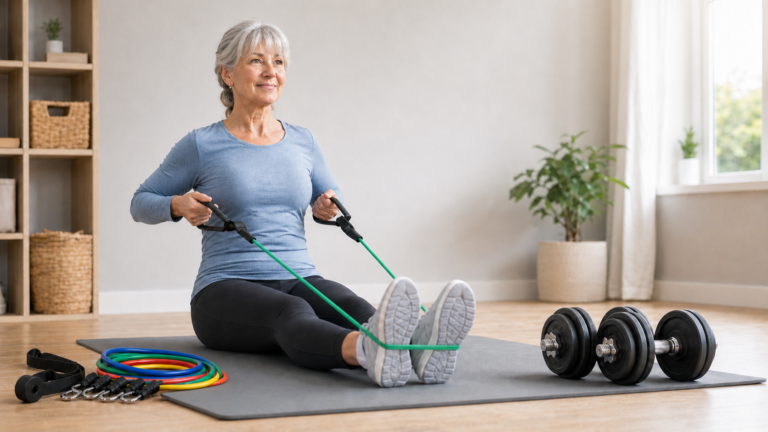
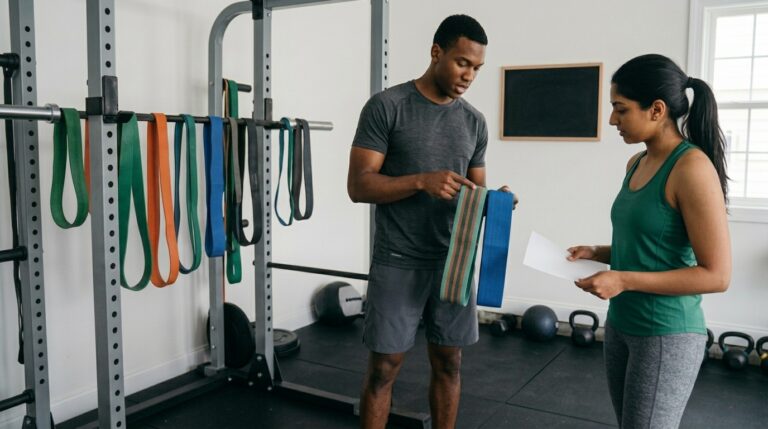
- A set of resistance bands. Mine were $28 on Amazon — I use the Bodylastics resistance bands and three years later, they’re still fine.
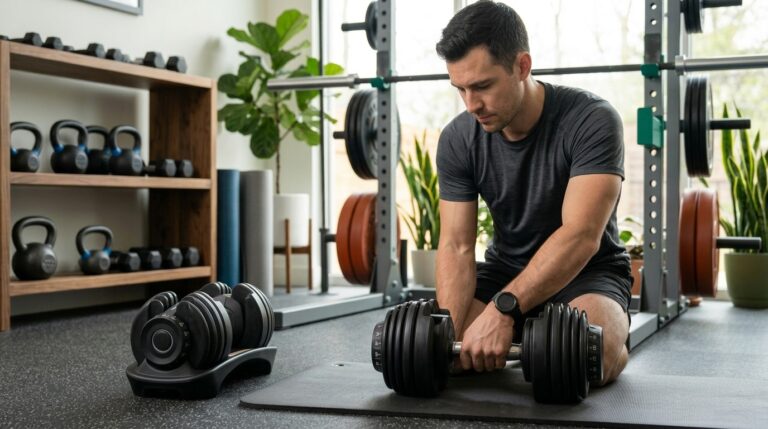
- A way to add weight to basic movements. I use 25-lb adjustable dumbbells. You could use a backpack with books in it. Seriously.
- A chair. Any chair, as long as it doesn’t slide.
- Roughly six square feet of floor.
That’s the entire equipment list. Anyone telling you that you need more than this past 50 is selling something.
The Five Moves of My Strength Training Over 50 at Home Routine
I tried, in my first three months, to do about twenty different exercises. I had spreadsheets. I watched YouTube videos at 1.5x speed. I was, in retrospect, completely overcomplicating it.
The truth is that strength training over 50 at home boils down to five movement patterns, and if you do those well, the rest is decoration.
Push Something
Push-ups, against the wall if you need to start there. I started against the wall. There is no shame in starting against the wall. The people who tell you wall push-ups don’t count have never watched a 56-year-old try a real one for the first time.
Pull Something
Resistance bands are perfect for this — anchor them around a sturdy door or a heavy table leg, grab the handles, pull toward your chest. Pulling movements are critical because most of us spend our lives slumped forward at screens, which destroys posture in ways you only notice when someone takes a candid photo.
Squat
Or, if squats are scary, just sit on a chair and stand up. Repeatedly. That’s a squat with extra steps. Aim for ten, then twelve, then fifteen. The day you can do twenty without thinking about it is the day your knees stop being scared of stairs.
Hinge at the Hips
Hold a dumbbell in front of you. Push your butt back like you’re closing a car door without your hands. Stand up. This trains the muscles that protect your lower back, which is the body part that’s going to give you trouble at some point if you don’t take care of it.
Carry Heavy Things
This is the one nobody talks about, and it’s secretly one of the most useful. Pick up two heavy grocery bags. Walk around the house for two minutes. Done. Almost every part of your body works during a heavy carry, and the practical carryover (literally) into daily life is enormous.
That’s the list. Five movements. You can build a whole strength program out of these and never need anything else.
The Schedule That Makes Strength Training Over 50 at Home Stick
Three days a week. I do Mondays, Wednesdays, and Saturdays, but the days don’t matter — what matters is that you have rest days between them.
A session takes about 25 minutes. I don’t time it strictly. The whole thing looks roughly like this:
- Five minutes warming up. Marching in place, arm circles, gentle bodyweight squats. The goal is to be slightly warm, not tired.
- Three rounds of five exercises. Eight to twelve reps each. Slow on the way down, controlled on the way up. No bouncing.
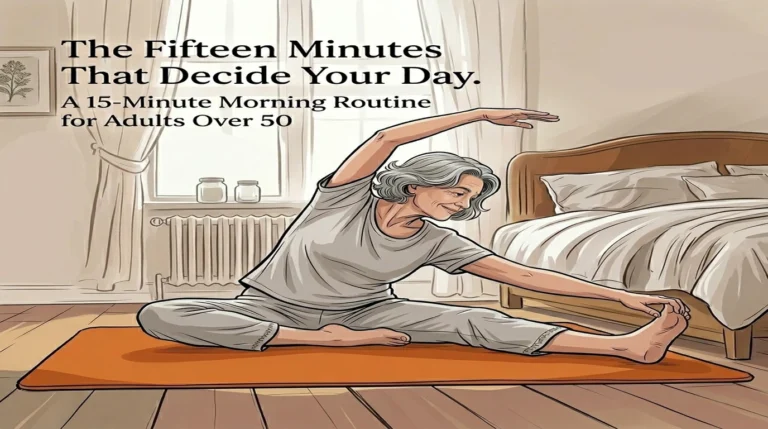
- Three or four minutes stretching whatever I just worked.
That’s the entire program. People expect strength training to be more elaborate than it is, and that expectation is exactly what stops most folks from starting.
The Mistakes I Made With Strength Training Over 50 at Home
Going Too Heavy Too Fast
Week one I cranked the bands up to maximum tension because I’d been lifting groceries my whole life and figured I was tough. I tweaked my left shoulder and lost ten days. Start lighter than you think. You can always add resistance. You can’t un-pull a rotator cuff.
Skipping Rest Days
I assumed more was better. It is not. Muscles grow during recovery, not during training. Three sessions a week with rest days between them is, for our age group, genuinely the sweet spot. Six days a week is how you get injured.
Refusing to Track Anything
For my first three months I just “did some exercises” and wondered why I wasn’t making progress. The week I started writing reps and weights in a cheap notebook, everything started moving. Tracking is the boring thing that separates training from just exercising.
Comparing Myself to Thirty-Year-Olds on Instagram
This was the worst one mentally. The internet is full of incredibly fit people in their fifties, and all of them have either been lifting since college or have access to genetics most of us don’t. The right comparison is you-from-three-months-ago. That’s it.
What Two Years of Strength Training Over 50 at Home Changed
Twenty-six months in. I’m 58. Some honest changes:
I can carry both bags of groceries from the car to the kitchen in one trip without my forearms burning. That sounds trivial. It isn’t, when you remember when it stopped being possible.
My posture is better. Not because I tried to fix it but because the muscles that hold you upright actually got stronger.
I haven’t had a bout of low back pain in fourteen months. I used to have one every six to eight weeks, sometimes severe enough to miss work.
I sleep deeper. I have no idea why. It’s the most consistent change and the one I trust the least, but it’s there.
My balance is meaningfully better. I tested it accidentally last winter when I slipped on icy steps; I caught myself in a way I genuinely don’t think I would have two years ago.
I don’t look like a fitness model. I’m never going to. But I look and feel like a strong 58-year-old, which is exactly the bar I was aiming for.
How to Start Strength Training Over 50 at Home This Week
If you’ve never trained, here’s day one:
- Sit on a chair, stand up without using your hands, sit back down. Do ten of those.
- Stand at a wall, place your palms flat against it at chest height, do ten wall push-ups.
- Pick up a gallon of water in each hand and walk around your house for one minute.
That whole sequence takes maybe four minutes. It is, despite how trivial it looks, a complete beginner strength workout.
Do it three times this week. Next week, add a couple of reps. The week after, add a couple more.
The strongest 70-year-olds I know almost universally started training in their fifties or sixties. They aren’t lifelong gym people. They’re regular people who decided one day that “soon” had been “soon” for too long and finally started. Strength training over 50 at home is the simplest, most reliable way to join them.